
A True Story of Seamanship and Survival in the North Atlantic (February 1966)
The Historical and Meteorological Background
The winter of 1965–1966 was destined to be recorded in maritime history as one of the wildest and most merciless of the twentieth century. According to historical meteorological data, that period was marked by an exceptionally aggressive, negative phase of the North Atlantic Oscillation (NAO). This atmospheric pattern dramatically weakened the Azores high-pressure system, opening a free and deadly corridor for the formation of explosive cyclones – what today we call “bomb cyclones”.
These systems swept the shipping lanes with hurricane-force winds.
On 3 February 1966 – the very same day the “Richard D. Lyons” sailed from Bremen – ESSA-1, one of the first fully operational weather satellites, was launched, followed on 28 February by ESSA-2.
Mankind was taking its first steps in observing the weather from space.
The first grainy, black-and-white images arriving at the ground laboratories revealed enormous spiral whirls of cloud over the North Atlantic. They were the visual confirmation of what the shipping bulletins named with awe: a “Complex Storm”.
A system with multiple centres of low pressure rotating around one another, creating a chaotic, unpredictable field of winds and giant waves.
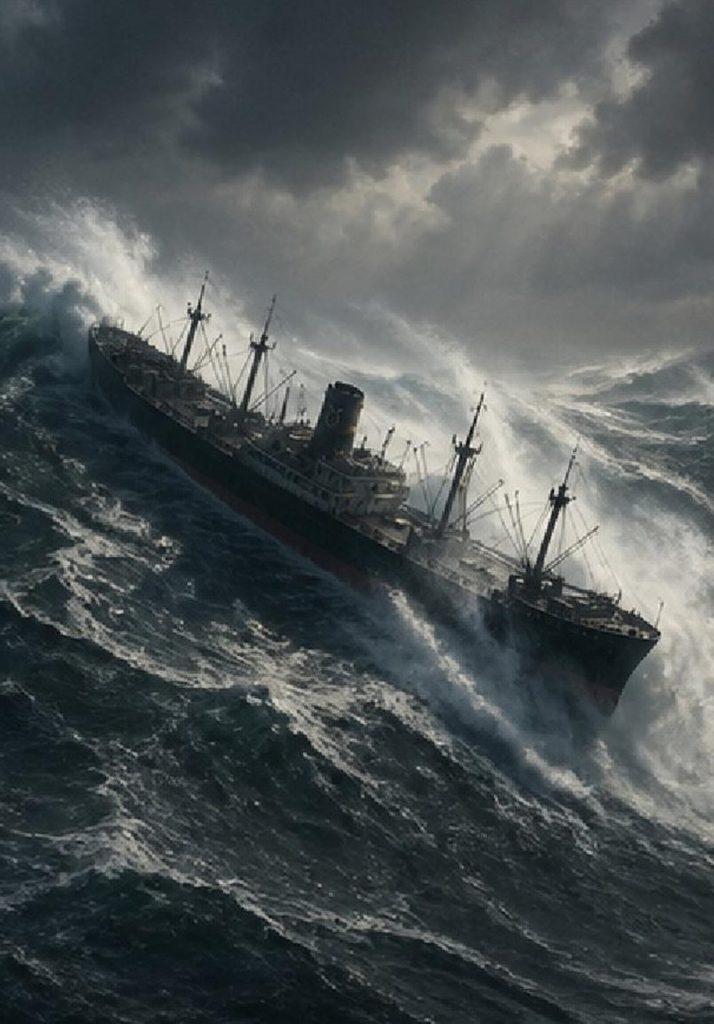
Trapped in this clashing rock of ocean and atmosphere was an ageing Second World War hull, manned by thirty-two Greek seamen.
This is their true story, from the records of Chief Officer Christoforos (then 28 and now 88 years old).
His grandson Christoforos (9 years old) asked Grandpa Christoforos to write down this and other short true stories from his many voyages in the Northern and Southern Hemispheres of the earth. That is why Grandpa dedicates it to his beloved grandson Christoforos.